


Imagine you manufacture roasted snacks. Your packaging looks attractive, the printing is clear, and the pouches arrive in good condition. But after a few weeks, customers complain that the snacks have lost their crispness. The problem may not be the product itself. It could be the packaging structure, seal quality, or storage conditions.
Now consider another situation: you purchase expensive, high-barrier laminated pouches for a product that does not need that level of protection. Your packaging cost increases, but the additional material may not provide a meaningful benefit.
Both situations highlight an important point: the best laminated packaging is not necessarily the thickest, most expensive, or most visually attractive option. It is the structure that meets your product’s actual requirements.
For manufacturers, food brands, retailers, and businesses purchasing packaging in bulk, understanding laminated packaging helps make better decisions about material selection, product protection, printing, and overall cost.
In this blog, we will cover what laminated packaging is, how its layers work, the materials used to create it, and the questions you might want to ask a manufacturer when placing a bulk order.
What Is Laminated Packaging? Meaning and Definition
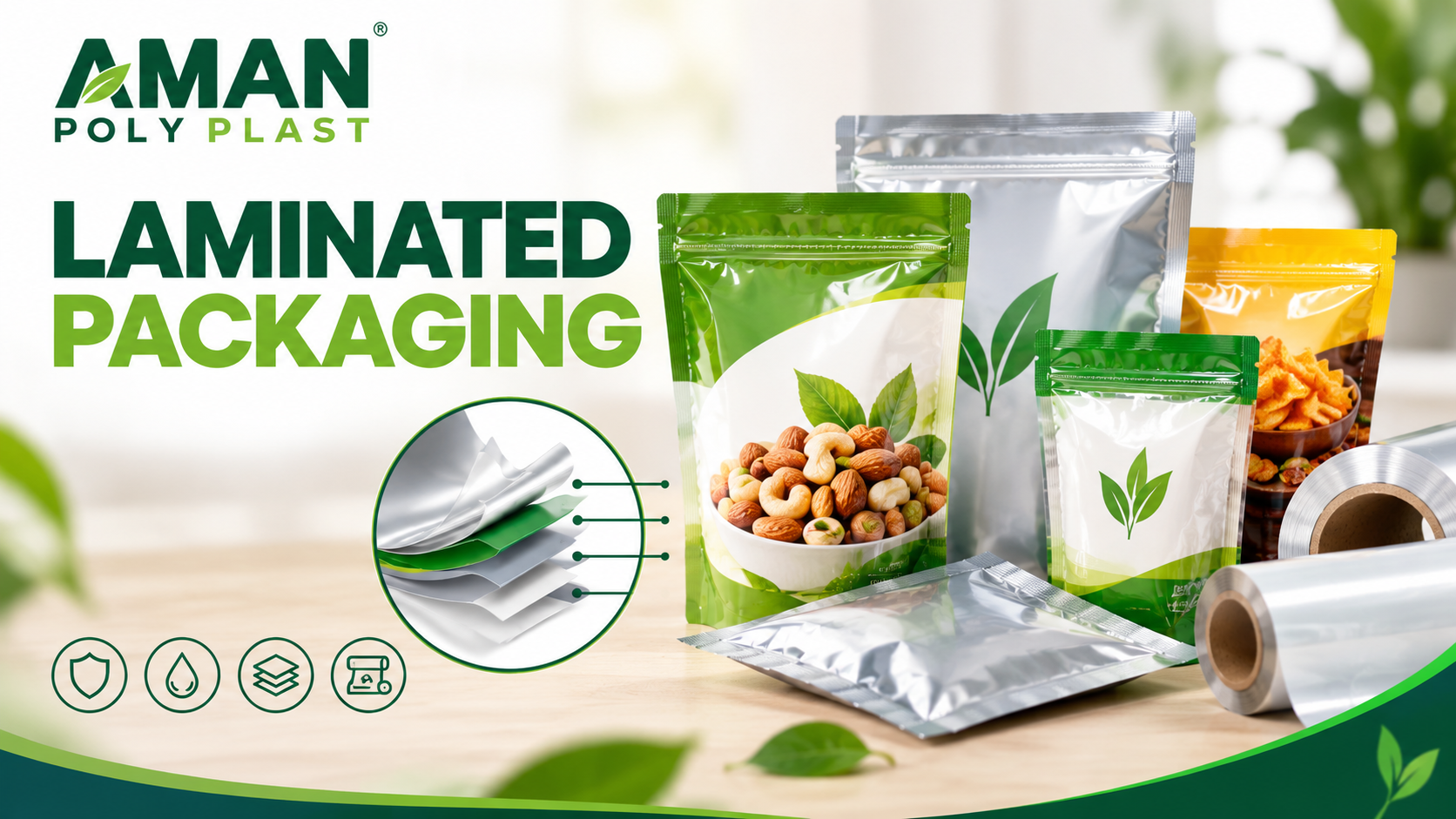 Laminated packaging is packaging made by bonding two or more layers of materials together to create a structure with specific functional properties. These layers may be different plastic films, Aluminium foil, or other suitable materials, depending on the intended application.
The purpose of lamination is to combine useful properties that a single material may not provide on its own.
For example, one material may offer a suitable surface for printing, another may provide additional barrier protection, and an inner layer may allow the package to be heat-sealed.
The resulting material can be converted into laminated pouches, flexible bags, roll-stock films, and other packaging formats.
A Simple Example of How Laminated Packaging Works
Suppose a business wants to package a powdered food product.
The packaging may need to:
-
- Display the brand name, product information, and design.
-
- Help limit moisture exposure.
-
- Maintain a reliable seal after filling.
-
- Withstand normal handling and transportation.
Instead of expecting one film to meet every requirement, the manufacturer can select a combination of materials designed to perform different functions.
The final structure must be selected according to the product, required shelf life, filling process, and storage conditions.
How Does Laminated Packaging Work? Understanding the Layers
A laminated packaging structure may contain two, three, or more layers. Each layer has a purpose, although its exact role depends on the materials selected.
| Packaging Layer | Main Function | What a Buyer Should Check |
| Outer layer | Supports printing, presentation, and handling | Print quality, surface properties, and mechanical performance |
| Intermediate layer | May provide additional strength or barrier protection | Required barrier performance and material compatibility |
| Inner sealing layer | Forms the package seal and contacts the product where applicable | Seal strength, sealing conditions, and product compatibility |
These are general functional roles rather than fixed rules. Some structures combine several functions in one layer, while others require additional layers.
Laminated Packaging Materials: Which One Should You Choose?
Different packaging materials provide different characteristics. The decision should begin with the product’s requirements rather than a preferred material name.
| Material | Common Packaging Role | Important Consideration |
| PET | Printable outer film and structural support | Check print requirements and mechanical performance |
| PE | Flexible sealing layer in many structures | Check sealing behaviour and product compatibility |
| BOPP | Retail presentation, printing, and packaging films | Check the film grade, sealing properties, and application |
| Metallized film | Additional barrier protection in selected structures | Performance depends on coating quality and construction |
| Aluminium foil | High barrier against moisture, oxygen, and light when correctly incorporated | Consider cost, forming requirements, and the protection actually needed |
These materials are not direct substitutes for one another. They are selected and combined according to the application.
Which Laminated Packaging Structure Is Suitable for Your Product?
The following examples illustrate how packaging requirements differ.
| Product or Application | Main Concern | What to Discuss With the Manufacturer |
| Roasted snacks | Crispness, moisture, and oxygen exposure | Required barrier performance and seal integrity |
| Spices | Aroma retention and moisture exposure | Aroma protection, material compatibility, and sealing |
| Powdered products | Moisture ingress and leakage | Barrier requirements and seal performance |
| Liquid products | Leakage and chemical compatibility | Liquid-compatible structure, seal integrity, and filling conditions |
| Seeds | Moisture exposure during storage | Storage conditions and required moisture protection |
| Garments | Dust, handling, and presentation | Bag format, clarity, strength, and printing requirements |
These are starting points for discussion, not final material specifications. Actual suitability depends on the product and operating conditions.
Laminated Packaging vs. Single-Layer Plastic Packaging
One of the most common purchasing questions is whether a business actually needs laminated packaging or whether a single-layer plastic film will be sufficient.
The answer depends on what the packaging needs to do.
| Comparison Factor | Single-Layer Plastic Packaging | Laminated Packaging |
| Material construction | Primarily one material layer | Two or more bonded material layers |
| Functional properties | Depends on the selected film | Properties can be combined through material selection |
| Barrier performance | Depends on the particular film | Can be tailored through suitable layer combinations |
| Printing | Depends on the film and printing process | Multiple material and printing combinations may be available |
| Sealing | Depends on the material grade | Depends on the inner sealing layer and complete structure |
| Recycling considerations | May be easier to recycle where the material is accepted | Multilayer construction may complicate recycling |
| Cost | Depends on film type, thickness, and quantity | Depends on material combination, thickness, printing, and conversion |
Lamination may be worthwhile when the product needs a combination of properties that a suitable single-layer film cannot provide adequately.
For example, a product may require a printable outer surface, improved barrier protection, and a compatible heat-sealing layer.
However, if a product has relatively simple packaging requirements, a single-layer material may be sufficient.
The right decision is to compare the required performance against the complete packaging cost—not to assume that multilayer packaging is always better.
How to Choose Laminated Packaging Without Wasting Money
A packaging quotation is useful only when you understand what you are buying.
Before comparing suppliers, answer the following questions.
1. What Exactly Are You Packaging?
Start with the product itself.
Is it a dry powder, granular material, snack, liquid, garment, or industrial component?
Consider whether it contains oil, reacts with moisture, releases aroma, or requires protection from light.
A packaging structure suitable for garments may not be appropriate for moisture-sensitive food products.
2. What Problem Must the Packaging Prevent?
Avoid asking for a particular material before identifying the problem.
Instead, define the requirement:
-
- Does the product lose quality when exposed to moisture?
-
- Is oxygen exposure a concern?
-
- Does the product require protection from light?
-
- Could the package leak during transportation?
-
- Does the package need to withstand puncture or compression?
-
- Must the packaging remain sealed during a long distribution journey?
The answers help the manufacturer recommend an appropriate structure.
3. How Long Must the Product Remain Stable?
Shelf life cannot be determined by packaging material alone.
Product formulation, processing, storage temperature, humidity, filling conditions, and packaging integrity all affect the result.
If your product requires a specific shelf life, communicate that requirement to the manufacturer and arrange appropriate validation.
Do not assume that switching to a thicker or metallized pouch will automatically achieve the desired shelf life.
4. Which Pouch Format Do You Need?
The format should match the product, filling equipment, storage method, and intended customer experience.
| Pouch Format | When It May Be Suitable |
| Three-side seal pouch | Flat packs and selected single-use applications |
| Centre-seal pouch | Certain automated packaging operations |
| Stand-up pouch | Products that benefit from upright presentation |
| Zipper pouch | Products that need a compatible resealable closure |
| Spouted pouch | Selected liquids and pourable products |
A pouch format does not determine the barrier performance by itself. The material structure and finished package must also meet the product’s requirements.
5. What Is Your Actual Packaging Cost?
Do not compare quotations using price per pouch alone.
A cheaper package may create additional costs if it causes production delays, higher rejection rates, product damage, or sealing problems.
When comparing suppliers, consider:
-
- Cost per finished pouch.
-
- Material specifications and thickness.
-
- Printing and any applicable setup costs.
-
- Minimum order quantity.
-
- Wastage during filling and sealing.
-
- Transportation and storage requirements.
-
- Product damage and rejection rates.
The practical goal is to find the lowest overall cost for packaging that reliably meets your requirements—not simply the lowest unit price.
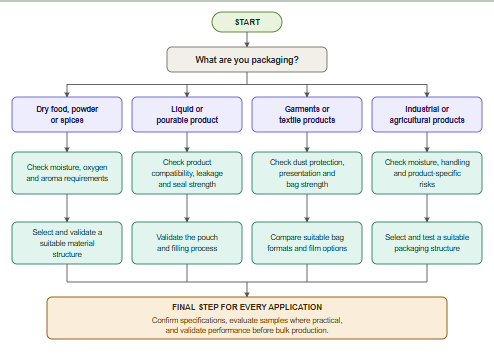
A Practical Decision Graph for Selecting Laminated Packaging
Use this decision guide before requesting a quotation.
Why Laminated Packaging Can Fail Even When the Material Looks Good
A common purchasing mistake is evaluating packaging only by its appearance.
A pouch can have attractive printing and still perform poorly if its seal is weak, its material structure is unsuitable, or its construction is incompatible with the filling process.
Consider these examples.
Problem 1: The Product Loses Crispness
Possible causes include insufficient barrier protection, poor sealing, unsuitable storage conditions, or problems with the product itself.
What to do: Evaluate the complete package, including its material structure, seal integrity, and storage conditions. Do not assume that adding another layer will solve the problem without testing.
Problem 2: Pouches Leak During Filling
Possible causes include unsuitable sealing conditions, contamination in the seal area, incorrect material selection, or inconsistent sealing performance.
What to do: Check the sealing layer, filling process, sealing temperature, pressure, and dwell time. Test the finished package under representative conditions.
Problem 3: The Packaging Cost Is Higher Than Expected
Possible causes include unnecessary material specifications, unsuitable pouch dimensions, excessive material usage, printing costs, or avoidable production wastage.
What to do: Review the material specification and packaging design against the product’s actual requirements. Any proposed reduction in material or thickness should be validated before implementation.
Problem 4: The Package Does Not Run Properly on the Filling Machine
A pouch or roll-stock film may be unsuitable for the equipment, sealing conditions, or required production speed.
What to do: Share the filling machine specifications and operating conditions with the manufacturer before approving the final material.
These examples show why packaging should be evaluated as a complete system rather than as a film or pouch in isolation.
What Should You Ask a Laminated Packaging Manufacturer?
Before placing a bulk order, use this checklist to compare suppliers on more than price.
| Question | Why It Matters |
| What is the complete material structure? | Helps you understand the materials being supplied |
| What barrier performance can you demonstrate? | Connects material selection to the product’s requirements |
| What is the thickness of each relevant layer or the total structure? | Helps clarify the specification being quoted |
| Is the structure compatible with our filling machine? | Reduces the risk of production problems |
| What tests are available for seal strength or leakage? | Helps establish whether the finished package meets the required performance |
| Can we evaluate samples before bulk production? | Helps identify potential issues before committing to a large order |
| What is the minimum order quantity? | Helps with inventory and purchasing decisions |
| What printing and customisation options are available? | Clarifies branding and design possibilities |
| What are the end-of-life options for this structure? | Helps assess recycling and waste-management considerations |
A reliable supplier should be able to explain the recommended structure, provide relevant specifications, and clarify what needs to be tested.
Laminated Packaging Solutions for Business Requirements
Aman Poly Plast Pvt. Ltd. has been operating in the packaging industry since 2009 and provides packaging solutions for different business applications.
For businesses evaluating laminated packaging, the discussion should begin with the product and its requirements.
Before requesting a quotation, prepare the following information:
-
- Product: What will the package contain?
-
- Dimensions: What finished pouch or bag size do you require?
-
- Performance: Is moisture protection, oxygen control, liquid containment, or mechanical strength important?
-
- Printing: Do you need custom branding or product information?
-
- Quantity: What is your expected order volume?
-
- Filling process: Will the product be packed manually or using automated equipment?
Providing these details makes it easier to assess suitable material options, pouch formats, and production requirements.
If you are comparing laminated packaging suppliers, request the proposed material structure and relevant specifications before approving a bulk order.
You can also review the relevant flexible laminates packaging solutions offered by Aman Poly Plast.
Conclusion
Laminated packaging is not simply a more advanced version of ordinary plastic packaging. It is a way to combine material properties for a particular application.
The right structure depends on what the product needs protection from, how the package will be filled and sealed, how it will be stored, and how much performance the application actually requires.
Before committing to bulk production, compare specifications, ask for evidence of relevant performance, and test the package under realistic conditions.
Choose laminated packaging based on product requirements—not assumptions about thickness, layer count, or price.
Frequently Asked Questions
1. What does laminate packaging mean?
Laminate packaging means packaging made by bonding two or more material layers together. The layers are selected to provide a combination of properties, such as printability, strength, barrier protection, and heat-sealing performance.
2. What is the difference between lamination and laminated packaging?
Lamination is the process of bonding materials together. Laminated packaging is the finished packaging material or product created using that process.
3. Which laminated packaging is best for food products?
There is no single best structure for all food products. The appropriate material depends on moisture and oxygen sensitivity, aroma retention, product composition, filling conditions, storage environment, and shelf-life requirements.
4. Is three-layer laminated packaging better than two-layer packaging?
Not automatically. A three-layer structure may provide useful additional properties, but the number of layers alone does not determine performance. The actual materials, their thicknesses, barrier properties, and seal compatibility are more important.
5. Is laminated packaging waterproof?
Some laminated structures provide good resistance to moisture, but performance varies by construction. Resistance to water exposure is not the same as preventing water vapour transmission, and neither should be assumed without checking the material specifications.
Choose laminated packaging based on product requirements—not assumptions about thickness, layer count, or price.