



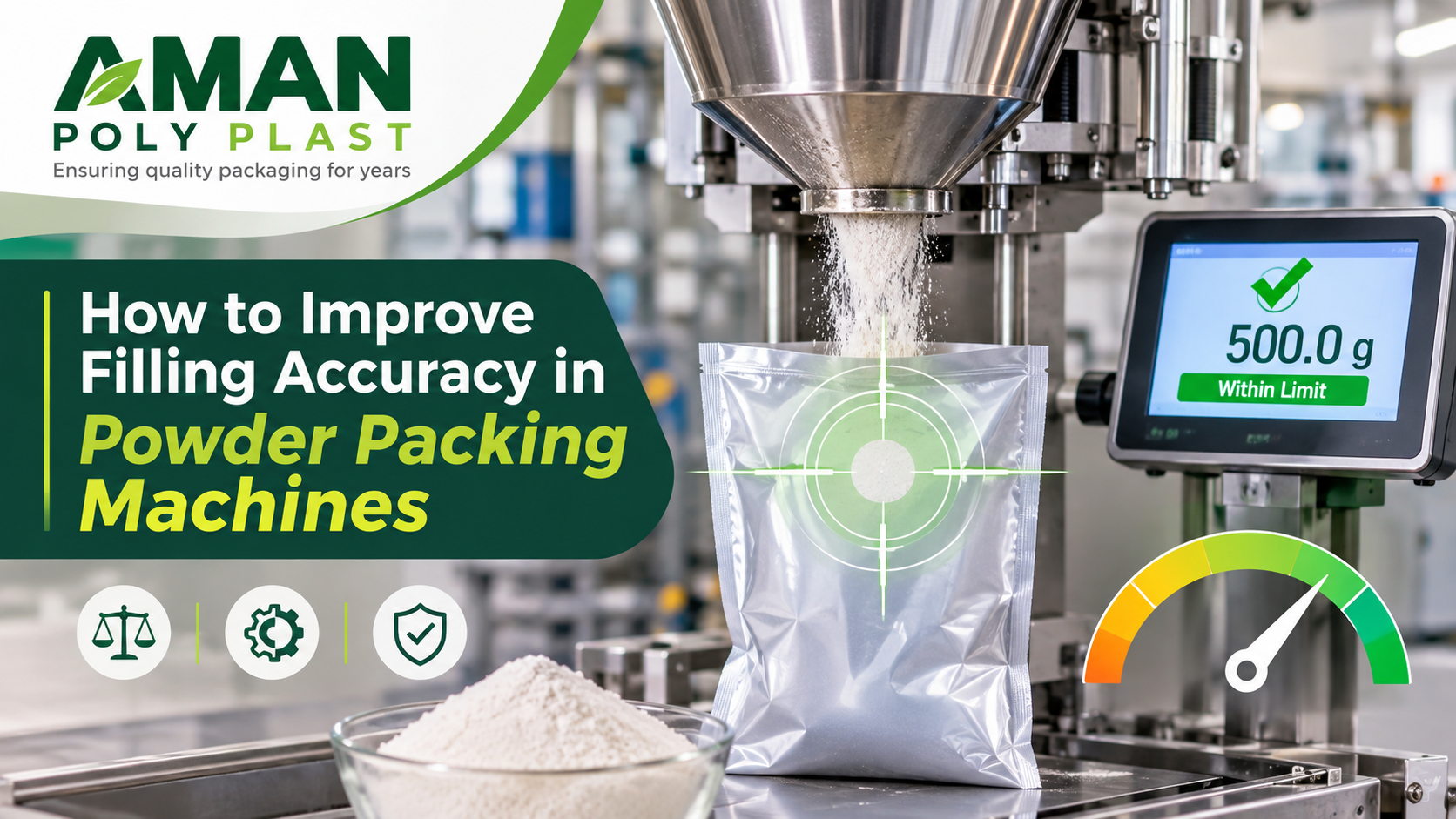
Filling inconsistencies are a common challenge in powder packaging operations. Variations in pouch weight can lead to product wastage, rejected packs, and increased production costs. Powder packing machines are designed to maintain accurate and consistent filling, but machine performance alone does not determine the final results. Factors such as powder characteristics, surrounding environmental conditions, machine settings, filling speed, and packaging film can all affect filling accuracy. Understanding these factors is essential to identifying the causes of weight variations and maintaining consistent filling throughout the production process.
Why Is Filling Accuracy Important in Powder Packing Machines?
Powder is sold by weight, so a few grams here and there matter more than people think. Say your target is 500 g and the packs average 506 g. That’s 6 g of free product in every pouch. At 20,000 packs a day, you hand over 120 kg for nothing.
Underfilling hurts in a different way. Short packs bring customer complaints, audit trouble, and sometimes fines under net-content rules. For pharma and nutrition products, a wrong fill can even mean a wrong dose for the person using it.
Tight accuracy saves money, keeps regulators happy, and protects your name on the shelf. That’s why experienced plant managers track the performance of their powder packing machines the same way they track sales – every day, with numbers.
What Causes Inaccurate Filling in Powder Packing Machines?
When weights drift, most teams look at the machine first. It’s usually smarter to look at the whole chain. In our experience the usual suspects are:
- The powder – poor flow, static, or density that changes between batches.
- Trapped air – fluffy powder fills the dosing unit with less product than you’d expect, then settles after packing.
- Worn parts – an auger with a chewed edge or a loose tube lets powder slip past.
- The hopper – bridging or rat-holing starves the feed.
- Calibration- load cells and sensors drift if nobody checks them.
- Speed – every powder has a pace where dosing falls apart.
- The film – weak seals leak after filling, which looks exactly like a dosing error.
Work through this list before you call the service engineer. Plenty of powder packing machines run fine once the surrounding problems are sorted out.
How Does Powder Flowability Affect Filling Accuracy?
Flowability simply means how easily powder moves under its own weight, and it has more say over accuracy than almost anything else.
Sugar, salt, and granular detergent flow like small beads. They fill cups and augers evenly, so volumetric filling usually works. Turmeric, cocoa, and talc are a different story. They cling together, build bridges in the hopper, and leave air pockets, so they need an auger filler with an agitator that suits them. Then you have milk powder and protein blends, which carry a lot of air. Their density shifts as they settle, so the same scoop can weigh different amounts an hour apart.
How to Maintain Consistent Filling Accuracy During High-Speed Production
Speed vs Accuracy – the two are often contradictory. The task is to set the fastest speed that your powder packers will still be able to maintain within the tolerance range.
The process starts with testing several cycles at various speeds and recording the weight variation for each one. There will be a moment when the variation begins to increase.
This is where you set your routine speed just below it. Here are some procedures to ensure stability from now on:
- Install a check weigher downstream of the filler and make sure that the results are used to correct the dose.
- Calibrate all scales and set points at the beginning of each shift and document the data.
- Change augers, tubes, and seals routinely before any reject cycle occurs.
- Clean sensors and sealing jaws from dust.
- Store your tested settings as recipes in the PLC to give all operators the starting point.
- Monitor the trend. If the mean value increases or the variation spreads, something has changed.
Do Not Overlook the Packaging Material
Accuracy doesn’t end when powder lands in the pouch. If the film is uneven or the seal layer is weak, the product can leak or puff out, and a perfectly dosed pack ends up light anyway.
That’s where good packaging earns its place. Aman Poly Plast manufactures multilayer laminated packaging that suits powdered products, with consistent thickness and dependable sealing. Their R&D keeps working on film strength and durability, and brands looking for greener options can check their compostable and eco-friendly bags. Pair a good film with well-tuned powder packing machines and your reject rate usually drops.
Conclusion
There’s rarely one big fix for filling accuracy. It comes from small, repeatable habits – the right dosing method, regular calibration, a stable room, and a speed your powder can handle. Packaging finishes the job. Even the best powder packing machines can’t save a pack whose film or seal gives way.
If you’re reviewing your setup or planning new packs, it helps to work with an ISO 9001:2015 certified partner like Aman Poly Plast. You can contact their team to talk through pouch and film options for your powder products.
Frequently Asked Questions
1. What should be the tolerance level for powder packing machines?
It could be up to ±0.5% or ±1%, depending on the powder being packed. The percentages will be greater when small sachets are packed.
2. Which filler will be more accurate, the auger filler or the volumetric cup filler?
Usually, the auger filler will be more precise. However, the cup filler works perfectly for uniform and free-flowing products.
3. When should powder packing machines be calibrated?
They should be calibrated at the beginning of each shift and after changing the product or the parts.
4. Could humidity influence the fill weight?
Yes. The humidity influences the packing and flow properties of the powder, thus its density.
5. Will the packaging film influence the accuracy of filling?
Not directly, but indirectly yes. Because of the poor quality of sealing and leakage, powder loss could make the pack underweight.