

Powder packaging machine
Powder products are used across some of the fastest-growing industries in India, from spices and flour to pharmaceuticals, nutraceuticals, chemicals, and cosmetics. But packaging a powder is not as simple as putting the product into a pouch and sealing it.
Fine particles can create dust, settle unevenly, absorb moisture, leak through weak seals, or affect filling accuracy. This is why choosing the right powder packaging machine and the right packaging material is important for manufacturers that want consistent packs, lower product wastage, and reliable production.
For businesses operating in India, the packaging decision also depends on the type of powder, pack size, production volume, pouch format, barrier requirements, and compatibility between the packaging film and the machine.
This guide explains how powder packaging machines work, the major machine types, their applications, the role of packaging materials, and what businesses should consider when developing a powder packaging solution in India.
What Is a Powder Packing Machine?
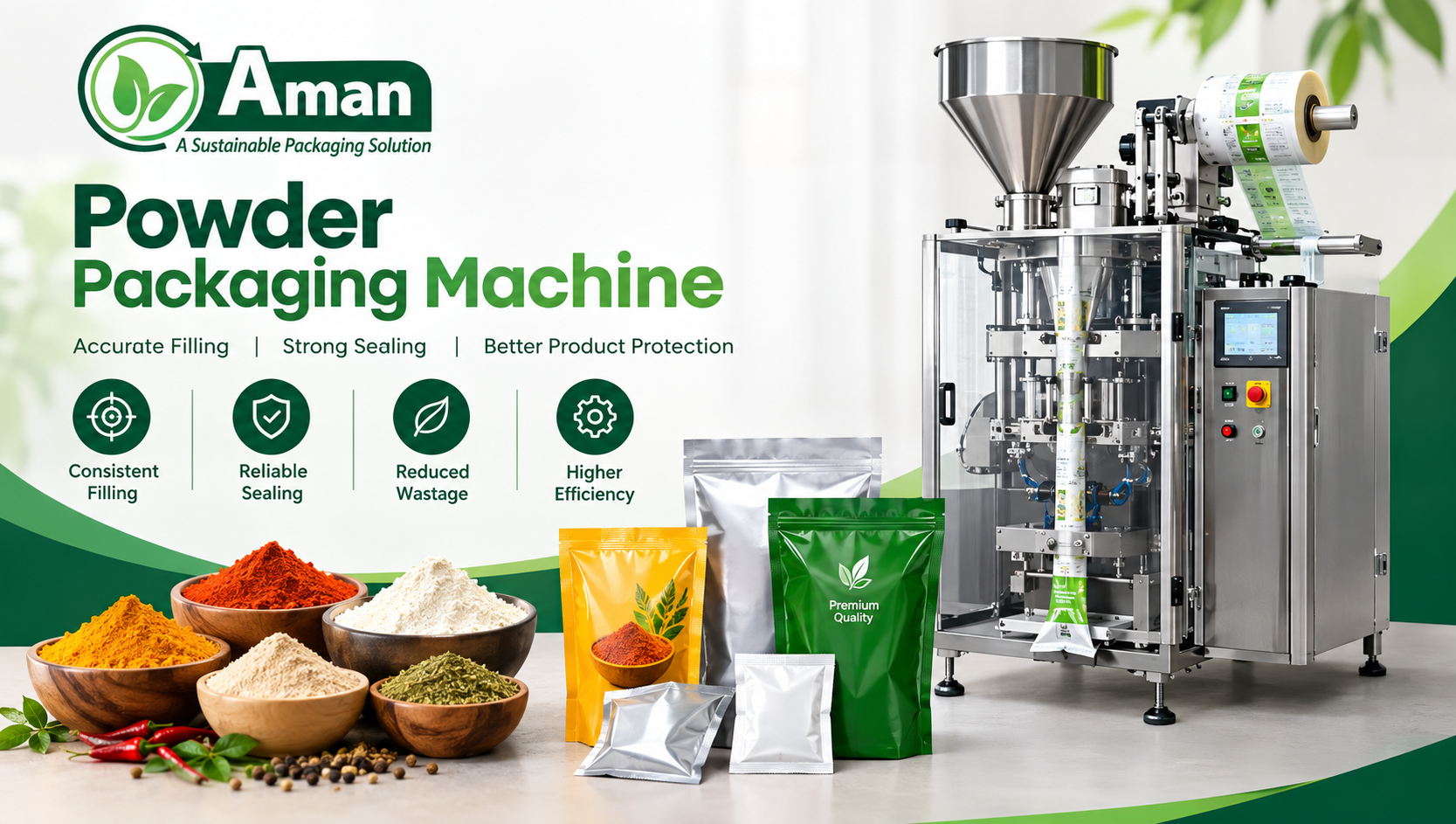
A powder packaging machine is equipment designed to measure, fill, and seal powdered products into a defined packaging format. Depending on the machine configuration, the product may be packed into sachets, pouches, laminated bags, or other suitable containers.
The filling system is selected according to the characteristics of the powder. A free-flowing powder behaves differently from a fine or cohesive powder, so the filling mechanism, dosing method, machine settings, and packaging format all influence the final result.
Modern powder packing systems can automate several stages of the process, including:
- Measuring or dosing the powder
- Filling the packaging
- Forming pouches where required
- Heat sealing
- Cutting individual packs
- Batch or date coding
- Counting finished packs
For manufacturers, the objective is not simply to pack faster. A suitable machine should provide repeatable filling, dependable sealing, controlled product handling, and compatibility with the chosen packaging material.
How Does a Powder Packaging Machine Work?
The exact operating process varies by machine type, but an automated powder packaging line generally follows a series of controlled steps.
1. Powder Feeding
The product is supplied to the machine through a hopper or feeding system. The design needs to accommodate the flow characteristics of the particular powder.
2. Dosing and Filling
The machine measures a predetermined quantity of powder and transfers it into the pouch, sachet, or container.
For many powder applications, an auger-based filling system is used because the screw mechanism can control the quantity being dispensed.
3. Pouch Formation
In a vertical form-fill-seal system, packaging film is formed into a pouch before the product is introduced.
4. Sealing
The filled package is sealed using the machine’s sealing system. Seal quality is particularly important for powder products because particles caught in the sealing area can affect seal integrity.
5. Cutting and Discharge
The machine separates the finished packs and transfers them for collection, secondary packing, inspection, or further processing.
This is where machine performance and packaging-film performance need to work together. A film may have good printing and barrier properties, but it also needs to run properly through the selected packaging equipment.
Types of Powder Packaging Machines
There is no single powder packing machine suitable for every product or production requirement. The right configuration depends on the powder, pack size, production volume, packaging format, and desired level of automation.
1. Auger Filling Powder Packaging Machine
Auger fillers use a rotating screw mechanism to measure and dispense powdered products.
They are commonly considered for applications involving products such as:
- Spice powders
- Flour
- Milk powder
- Protein powders
- Nutraceutical powders
- Pharmaceutical powders
- Selected chemical powders
The important advantage of an auger system is controlled dosing. However, the appropriate configuration and settings depend on the powder’s density, particle size, flow characteristics, and required filling quantity.
2. VFFS Powder Packaging Machine
Vertical Form Fill Seal, commonly called VFFS, is an automated packaging system in which the machine forms a pouch from a roll of packaging film, fills it with the product, and seals it.
A VFFS powder packaging machine can be suitable for businesses looking for an integrated packaging process and consistent output.
The benefits can include:
- Continuous pouch production
- Reduced manual handling
- Consistent packaging dimensions
- Efficient use of packaging film
- Integration with coding and other equipment
The packaging film must be selected with the machine’s forming, filling, and sealing process in mind.
3. Semi-Automatic Powder Packing Machine
Semi-automatic equipment can be useful for smaller manufacturers, businesses with moderate production requirements, or operations that are not ready for a fully automated packaging line.
Depending on the machine, an operator may handle part of the pouch-loading or feeding process while the machine performs the filling or dosing operation.
This approach can provide a practical balance between manual packaging and full automation.
4. Multi-Lane Powder Sachet Packing Machine
Multi-lane machines are designed for higher-volume sachet production. Multiple sachets can be produced during each machine cycle, making this configuration relevant to large-scale FMCG, pharmaceutical, food, and other powder-packaging applications.
The appropriate number of lanes depends on the required output, sachet dimensions, product characteristics, and machine configuration.
Types of Powder Packaging Machine
There is no single powder packing machine suitable for every product or production requirement. The right configuration depends on the powder, pack size, production volume, packaging format, and desired level of automation.
1. Auger Filling Powder Packaging Machine
Auger fillers use a rotating screw mechanism to measure and dispense powdered products.
They are commonly considered for applications involving products such as:
- Spice powders
- Flour
- Milk powder
- Protein powders
- Nutraceutical powders
- Pharmaceutical powders
- Selected chemical powders
The important advantage of an auger system is controlled dosing. However, the appropriate configuration and settings depend on the powder’s density, particle size, flow characteristics, and required filling quantity.
2. VFFS Powder Packaging Machine
Vertical Form Fill Seal, commonly called VFFS, is an automated packaging system in which the machine forms a pouch from a roll of packaging film, fills it with the product, and seals it.
A VFFS powder packaging machine can be suitable for businesses looking for an integrated packaging process and consistent output.
The benefits can include:
- Continuous pouch production
- Reduced manual handling
- Consistent packaging dimensions
- Efficient use of packaging film
- Integration with coding and other equipment
The packaging film must be selected with the machine’s forming, filling, and sealing process in mind.
3. Semi-Automatic Powder Packing Machine
Semi-automatic equipment can be useful for smaller manufacturers, businesses with moderate production requirements, or operations that are not ready for a fully automated packaging line.
Depending on the machine, an operator may handle part of the pouch-loading or feeding process while the machine performs the filling or dosing operation.
This approach can provide a practical balance between manual packaging and full automation.
The appropriate number of lanes depends on the required output, sachet dimensions, product characteristics, and machine configuration.
4. Multi-Lane Powder Sachet Packing Machine
Multi-lane machines are designed for higher-volume sachet production. Multiple sachets can be produced during each machine cycle, making this configuration relevant to large-scale FMCG, pharmaceutical, food, and other powder-packaging applications.
The appropriate number of lanes depends on the required output, sachet dimensions, product characteristics, and machine configuration.
Powder Packaging Machine Applications in India
Powder packaging is used across a wide range of industries. The packaging requirements can vary significantly between applications.
Food and Spice Packaging
India has a large market for powdered food products, including:
- Turmeric powder
- Chilli powder
- Coriander powder
- Spice blends
- Flour
- Coffee
- Milk powder
- Premixes
- Other powdered food products
Food powders need packaging that helps protect the product from moisture, contamination, handling damage, and other environmental factors.
For branded consumer products, the appearance of the pouch also matters. Printing quality, colour consistency, sealing, and overall pack presentation can influence how the product appears on retail shelves.
Pharmaceutical and Nutraceutical Packaging
Powder packaging is also used for pharmaceutical formulations, health supplements, nutraceuticals, and related products.
These applications can require greater control over hygiene, filling accuracy, traceability, and packaging performance. The specific packaging and machine requirements depend on the product and applicable regulatory and quality requirements.
Chemical Powder Packaging
Industrial and household chemical powders may include detergent powders, additives, processing materials, and other formulated products.
For these applications, packaging selection needs to consider factors such as product compatibility, moisture protection, mechanical strength, seal integrity, and the required pack size.
Cosmetic Powder Packaging
Face powders, herbal powders, cosmetic formulations, and other dry cosmetic products can also require specialized packaging.
Here, packaging has two jobs: protecting the product and presenting the brand effectively. The choice of film structure, finish, printing, pouch style, and pack size can therefore become part of the product’s overall presentation.
Why Packaging Material Matters as Much as the Machine
A common mistake is to look at the machine and packaging film as two completely separate decisions.
They are not.
A powder packaging machine has to handle the selected packaging material properly. The film needs suitable properties for forming, sealing, printing, barrier protection, and the intended end use.
For example, packaging for a moisture-sensitive powder may require stronger moisture-barrier properties than packaging for a product with lower sensitivity to humidity.
Depending on the application, packaging materials may need to provide:
- Moisture resistance
- Oxygen or aroma barrier
- Light protection
- Puncture resistance
- Appropriate stiffness
- Reliable heat sealing
- Good printability
- Machine compatibility
This is why manufacturers should consider the machine and packaging material together rather than selecting one without considering the other
Powder Packaging in India: What Should Manufacturers Consider?
The Indian market includes businesses ranging from small regional manufacturers to large FMCG, pharmaceutical, food, chemical, and consumer-product companies.
Their packaging requirements can be very different.
When developing a powder packaging in India, manufacturers should consider the following factors.
Product Characteristics
Start with the powder itself.
Is it free-flowing or cohesive? Does it absorb moisture? Is it dusty? Does its bulk density vary? Does it contain larger particles?
These characteristics influence the choice of filling and dosing system.
Pack Size
A machine designed for small sachets may not be the right solution for larger retail packs.
Define the required pack sizes before selecting the equipment and packaging format.
Production Volume
A business producing a few thousand packs per day may have very different requirements from a manufacturer operating a high-volume production line.
Machine speed should therefore be evaluated alongside actual production requirements rather than treated as the only performance measure.
Packaging Format
Powders can be packed in different formats, including:
- Sachets
- Pillow pouches
- Centre-seal pouches
- Laminated bags
- Pre-formed pouches
- Other application-specific formats
The desired format influences the machine configuration and packaging material.
Packaging Film Compatibility
The packaging film should be suitable for the machine’s forming and sealing process.
This includes consideration of film thickness, structure, sealing characteristics, surface treatment, printing requirements, and barrier performance.
Sealing Requirements
Powder particles can interfere with sealing if they enter the seal area. The packaging system therefore needs to provide an appropriate filling and sealing process for the product.
Good packaging is not just about appearance. The finished seal needs to perform its intended function throughout handling, transportation, storage, and distribution.
Benefits of Using a Powder Packaging Machine
Improved Filling Consistency
Automated dosing can provide greater consistency than manual filling when the machine is correctly configured for the product.
Faster Production
Automation can reduce the amount of manual handling involved and increase production efficiency.
Reduced Product Wastage
Controlled dosing and a properly designed filling process can help reduce unnecessary powder loss and spillage.
Better Hygiene and Handling Control
Reducing unnecessary manual contact can help manufacturers maintain better control over the packaging process, particularly where hygiene is an important consideration.
Consistent Pack Presentation
Automated pouch formation and sealing can help maintain consistency in pack dimensions and appearance.
Lower Dependence on Manual Packaging
For growing businesses, automation can reduce repetitive manual work and make production easier to scale.
However, these benefits depend on selecting an appropriate machine, maintaining it correctly, and using packaging materials that perform well with the equipment.
How to Choose the Right Powder Packaging Machine
Before investing in a powder packing machine, manufacturers should evaluate more than the machine’s advertised speed.
Ask these questions first:
What type of powder are you packaging?
The filling mechanism should match the product’s characteristics.
What pack sizes do you need?
The machine should accommodate your current requirements and, where practical, anticipated product formats.
How much do you need to produce?
Production volume determines whether a semi-automatic, automatic, or higher-output system makes sense.
What packaging format do you want?
Sachets, pouches, and other formats require different machine configurations.
What packaging film will you use?
The material should be evaluated for both product protection and machine performance.
How important are barrier properties?
Moisture, oxygen, light, aroma, and other environmental factors can affect packaging requirements.
What level of technical support is available?
Installation, machine settings, maintenance, spare parts, troubleshooting, and packaging-material support can all affect the long-term performance of a packaging operation.
The Role of Laminated Packaging Films in Powder Packaging
Laminated films are widely used for applications where packaging needs a combination of barrier protection, mechanical strength, printability, and sealing performance.
A laminated structure can combine different material properties within a single packaging construction.
For powder products, the appropriate structure may be selected according to:
- Product sensitivity
- Required shelf life
- Moisture protection
- Printing requirements
- Pack size
- Transportation conditions
- Machine requirements
- Desired finish and appearance
The exact structure should be selected according to the product and application rather than assuming that one film is suitable for every powder.
Why Work With a Packaging Partner Alongside the Machine Supplier?
Buying a powder packaging machine is only one part of setting up an efficient packaging operation.
The packaging material also needs to work with the machine and protect the product throughout its intended shelf life and distribution cycle.
Working with a packaging partner can help manufacturers coordinate requirements such as:
- Packaging film structure
- Printing
- Lamination
- Pouch dimensions
- Sealing requirements
- Machine compatibility
- Product protection
- Bulk supply requirements
This can be particularly useful when a manufacturer is launching a new powder product or changing its existing packaging format.
Powder Packaging Solutions by Aman Polyplast
Aman Polyplast Pvt. Ltd. provides packaging solutions for businesses that require printed and laminated packaging materials for different product applications.
For powder products, packaging selection can involve more than choosing an attractive design. The material needs to support the required level of product protection while also working effectively with the packaging process.
Depending on the application and requirements, manufacturers can evaluate packaging considerations such as:
- Laminated packaging films
- Printed packaging
- Product-specific packaging structures
- Machine-compatible packaging materials
- Custom packaging requirements
- Bulk packaging requirements
For manufacturers looking for powder packaging in India, the objective should be to develop a packaging solution around the product, machine, pack size, distribution conditions, and brand requirements rather than selecting material based on appearance alone.
Aman Polyplast can work with businesses to understand these packaging requirements and develop suitable packaging solutions based on the application.
Conclusion
A powder packaging machine can significantly improve the consistency and efficiency of a powder-product packaging operation, but the machine itself is only part of the solution.
The powder’s characteristics, filling mechanism, production volume, pouch format, sealing process, and packaging material all need to work together.
For businesses exploring powder packaging in India, the right approach is to start with the product and its packaging requirements rather than choosing equipment based solely on speed or price.
The same principle applies to packaging material. A well-designed printed laminate needs to provide the right balance of product protection, appearance, sealing performance, and machine compatibility.
For manufacturers working with powdered products, Aman Polyplast Pvt. Ltd. can help evaluate packaging-material requirements and provide printed and laminated packaging solutions suited to the intended application.
Frequently Asked Questions
1. What is a powder packaging machine?
A powder packaging machine is equipment used to measure, fill, and seal powdered products into pouches, sachets, bags, or other packaging formats. Depending on the system, it can automate several stages of the packaging process.
2. Which industries use powder packaging machines?
Powder packaging machines are used across food, spices, pharmaceuticals, nutraceuticals, chemicals, cosmetics, FMCG, and other industries that manufacture or distribute powdered products.
3. Which machine is suitable for powder products?
The appropriate machine depends on the powder’s flow characteristics, required filling quantity, production volume, packaging format, and desired level of automation. Auger-based systems are commonly considered for many powder applications, while VFFS systems can provide an integrated pouch-forming, filling, and sealing process.
4. What packaging material is suitable for powder products?
The suitable packaging material depends on the powder, required shelf life, moisture and oxygen sensitivity, pack format, sealing requirements, printing needs, and machine compatibility. Laminated films can be considered where a combination of barrier protection, strength, printability, and sealing performance is required.
5. What is powder packaging in India?
Powder packaging in India refers to the packaging of products such as spices, flour, food powders, pharmaceuticals, nutraceuticals, chemicals, detergents, and cosmetic powders into suitable pouches, sachets, bags, or containers. The packaging solution depends on the product, market, pack size, production requirements, and distribution conditions.