


Choosing a laminated pouches manufacturer in India is not simply about comparing prices per pouch. The wrong laminate structure, weak seals, inconsistent dimensions, poor print registration, or a mismatch with your filling process can create problems long after the purchase order has been placed.
For businesses ordering packaging in bulk, the more important question is whether the manufacturer can consistently produce pouches that perform the same way from the first batch to the next.
A laminated pouch may need to protect a moisture-sensitive product, withstand transportation, run smoothly on a filling machine, carry detailed printed graphics, or provide convenient features such as a zipper, spout, tear notch, or gusset. These requirements cannot be handled properly with a one-structure-fits-all approach.
This is why businesses should evaluate a laminated pouches manufacturer in India on material selection, laminate structure, printing, sealing, customization, quality control, production consistency, samples, and repeat-order capability—not quotation alone.
With more than 15 years of experience in flexible packaging, Aman Polyplast provides customized packaging solutions for businesses requiring application-specific pouch designs, printing, and flexible packaging performance.
What Should You Check Before Choosing a Laminated Pouches Manufacturer?
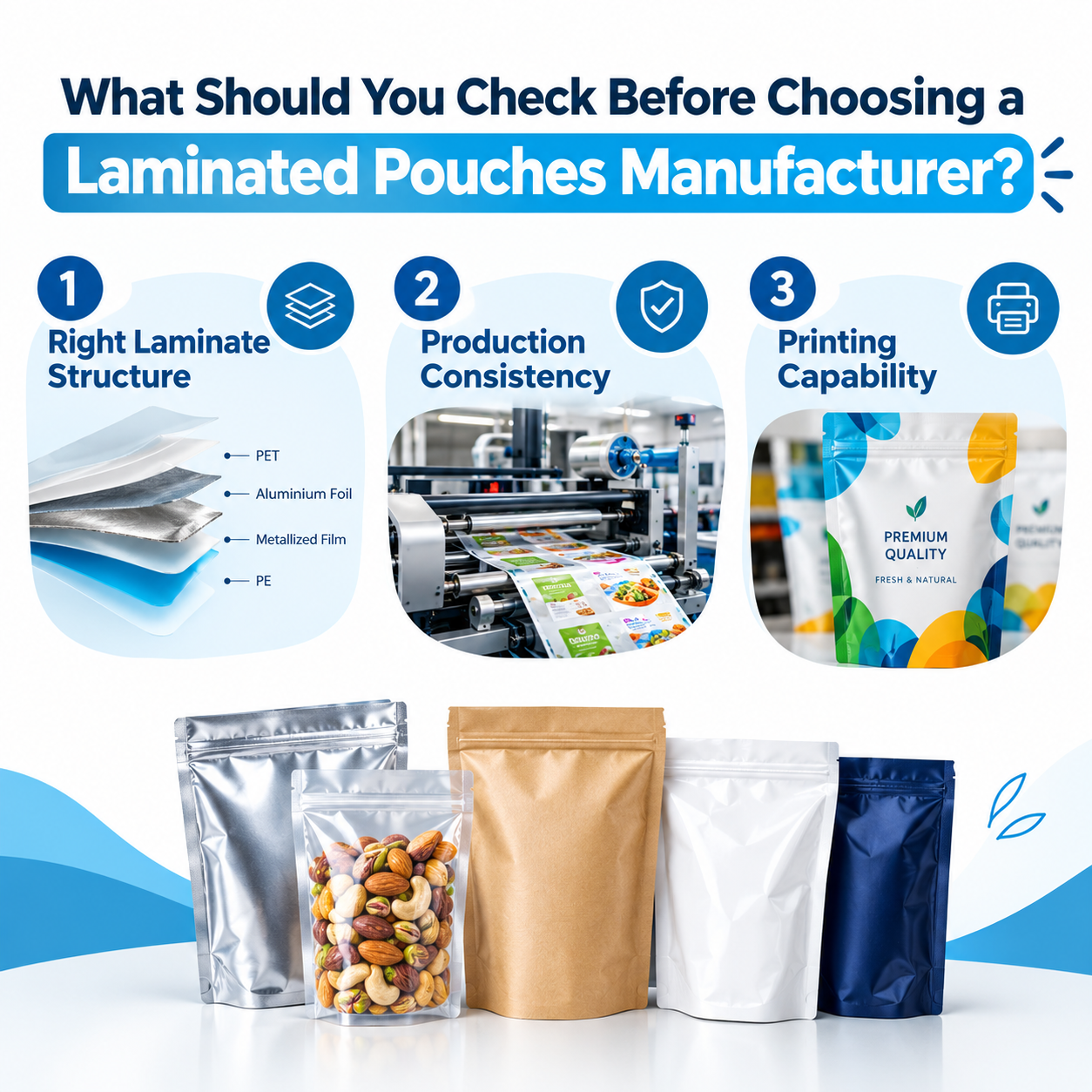
Before placing a bulk order, focus on the factors that can directly affect your finished packaging.
1. Can the Manufacturer Select the Right Laminate Structure?
The first question should not be, “What is the price?”
It should be, “Which laminate structure is suitable for my product?”
Different products have different packaging requirements. A dry food product may require protection from moisture and oxygen, while another application may require stronger sealing, better puncture resistance, or light protection.
Depending on the application, laminated pouches may use combinations involving:
-
- PET
-
- PE
-
- PP
-
- BOPP
-
- Aluminium foil
-
- Metallized films
-
- Other specialized packaging films
Each layer can perform a different function. PET may contribute strength and dimensional stability, PE can provide heat-sealing properties, while aluminium foil or metallized films can provide barrier performance.
A capable manufacturer should discuss the product, filling process, storage conditions, required protection, and intended application before recommending the structure.
2. Does the Manufacturer Maintain Production Consistency?
A sample can look excellent and still tell you very little about how the manufacturer will perform during a large production run.
For bulk packaging, consistency matters across:
-
- Material thickness
-
- Lamination
-
- Pouch dimensions
-
- Printing
-
- Seal strength
-
- Finishing
-
- Batch-to-batch production
The objective is not simply to receive one acceptable sample. The manufacturer should be capable of maintaining the agreed specifications throughout commercial production and repeat orders.
This becomes particularly important when the same packaging is ordered every month or when products are distributed across multiple locations.
3. What Printing Capability Do They Offer?
For many brands, the pouch is also part of the product presentation.
If your packaging carries a logo, product information, multiple colors, instructions, or detailed graphics, printing quality should be discussed before production.
Ask about:
-
- Printing technology
-
- Number of colors
-
- Print registration
-
- Ink suitability
-
- Print durability
-
- Matte or gloss finish
-
- Artwork requirements
-
- Repeat-order print consistency
For high-volume packaging, artwork approval and print consistency should be treated as part of the production process rather than an afterthought.
What Type of Laminated Pouch Do You Actually Need?
The pouch format should be selected according to the product, filling process, quantity, handling requirements, and desired presentation.
Stand-Up Pouches
Stand-up pouches have a bottom structure that allows them to remain upright after filling.
They are commonly considered for products such as:
-
- Snacks
-
- Dry fruits
-
- Coffee
-
- Spices
-
- Pet food
-
- Personal-care products
Zippers, tear notches, spouts, handles, and customized shapes can also be incorporated depending on the application.
Three-Side Seal Pouches
Three-side seal pouches have three sealed edges with an opening used for filling before final sealing.
They can be suitable for:
-
- Spices
-
- Powders
-
- Pharmaceutical products
-
- Nutritional products
-
- Food products
-
- Small-volume packaging
Their dimensions, thickness, laminate structure, and finishing can be customized according to the application.
Center Seal or Pillow Pouches
Center seal pouches have a longitudinal back seal along with top and bottom seals.
They are commonly used for products such as:
-
- Chips
-
- Biscuits
-
- Namkeen
-
- Snacks
-
- Confectionery
-
- Other dry food products
If the packaging will run on automated machinery, film specifications and machine compatibility should be discussed with the manufacturer before production.
Side Gusset Pouches
Side gusset pouches provide additional material along the sides, allowing the package to expand when filled.
They can be considered for:
-
- Tea
-
- Coffee
-
- Dry food products
-
- Bulk products
-
- Specialty packaging applications
The gusset dimensions should correspond with the product volume and required final appearance.
Spout Pouches
Spout pouches combine flexible packaging with a dispensing feature.
They can be suitable for applications involving:
-
- Sauces
-
- Juices
-
- Liquid food products
-
- Detergents
-
- Personal-care products
The pouch structure, spout size, sealing arrangement, and filling requirements should be considered together.
What Specifications Should You Give a Manufacturer?
One common reason for delays and unsuitable quotations is incomplete product information.
Before requesting a quotation, prepare the basic packaging specifications.
Product Information
Tell the manufacturer:
-
- What product will be packed?
-
- Is it solid, powder, liquid, or granulated?
-
- What is the required pack weight or volume?
-
- Is the product sensitive to moisture, oxygen, or light?
-
- Does it contain oil or acidic ingredients?
Pouch Requirements
Specify:
-
- Pouch type
-
- Width and height
-
- Required thickness
-
- Approximate capacity
-
- Closure requirement
-
- Tear notch requirement
-
- Spout or zipper requirement
-
- Window or gusset requirement
-
- Matte or gloss finish
Printing Requirements
Also provide:
-
- Number of colors
-
- Artwork
-
- Logo
-
- Required printing area
-
- Finish preference
-
- Any product information that must appear on the pouch
The more accurately these requirements are communicated, the easier it is for the manufacturer to recommend a suitable structure and provide a meaningful quotation.
Why Samples Should Be Approved Before Bulk Production
Do not treat a sample as a formality.
A sample gives you an opportunity to check whether the pouch actually works for your product and packaging process.
Review:
-
- Dimensions
-
- Material feel
-
- Thickness
-
- Printing
-
- Seal appearance
-
- Opening performance
-
- Zipper or closure operation
-
- Leakage resistance where applicable
-
- Overall compatibility with the product
Where possible, test the pouch with the actual product and filling process.
A pouch may look suitable when held in your hand but behave differently when filled, sealed, transported, or stored. Testing before bulk production can help identify such problems before they affect a large order.
How Important Is Quality Control in Laminated Pouch Manufacturing?
Quality control becomes more important as order volume increases.
A manufacturer should have processes for checking important production parameters such as:
-
- Film quality
-
- Lamination consistency
-
- Printing accuracy
-
- Pouch dimensions
-
- Material thickness
-
- Seal strength
-
- Finishing quality
-
- Batch consistency
For a business placing repeat orders, consistency is particularly important. The pouch supplied six months later should continue to match the agreed specifications rather than requiring the packaging team to adjust every time a new batch arrives.
Should You Choose a Laminated Pouches Manufacturer Near You?
Location can make procurement easier, but it should not be the deciding factor.
For businesses in and around Delhi NCR, working with a laminated pouches manufacturer in Delhi NCR can offer practical advantages such as easier communication, simpler sample coordination, and convenient logistics.
However, proximity does not automatically mean better manufacturing.
When comparing manufacturers, consider:
Material expertise + manufacturing consistency + printing capability + quality control + customization + service
and then consider logistics and location alongside these factors.
Where Are Laminated Pouches Used?
The flexibility of laminated structures allows them to serve different packaging requirements across industries.
Food Packaging
Laminated pouches can be used for products such as:
-
- Snacks
-
- Spices
-
- Dry fruits
-
- Coffee
-
- Tea
-
- Confectionery
-
- Ready-to-eat products
The laminate structure should be selected according to the product and required protection.
Pharmaceutical and Healthcare Packaging
Pharmaceutical and healthcare packaging requires careful consideration of material compatibility, hygiene, barrier requirements, and applicable regulatory requirements.
Suitable laminated structures can be considered for applications involving powders, supplements, medical products, and other healthcare products, depending on the specific packaging requirements.
FMCG and Personal Care
Laminated pouches can provide lightweight packaging, printed branding, and convenient formats for selected FMCG and personal-care applications.
Industrial Products
Certain industrial products can also require laminated packaging where protection from moisture, dust, or other external conditions is important.
What Separates a Reliable Manufacturer From a Basic Supplier?
The difference often becomes visible after the purchase order—not during the first sales conversation.
A reliable laminated pouch manufacturer should be able to:
-
- Understand the product before recommending materials
-
- Explain the proposed laminate structure
-
- Provide appropriate samples
-
- Discuss filling and sealing requirements
-
- Maintain agreed dimensions
-
- Maintain printing consistency
-
- Support customization
-
- Handle bulk production
-
- Maintain quality checks
-
- Support repeat orders with consistent specifications
This approach helps businesses reduce problems such as weak seals, inconsistent pouch sizes, print variation, unsuitable material structures, and packaging that does not perform properly on the filling line.
Why Choose Aman Polyplast for Laminated Pouches?
At Aman Polyplast, laminated packaging requirements are approached according to the product and application rather than through a single standard pouch structure.
With 15+ years of experience in flexible packaging, Aman Polyplast provides customized packaging solutions covering pouch size, laminate structure, printing, finishing, and functional features.
Based in Faridabad, Delhi NCR, the company serves businesses looking for flexible packaging solutions in the NCR region and across India.
For food, FMCG, pharmaceutical, retail, and other applications, the starting point is understanding what the product requires from its packaging.
Final Checklist Before You Place Your Order
Before finalizing a laminated pouches manufacturer in India, check these points:
-
- Is the laminate structure suitable for your product?
-
- Has the manufacturer understood your filling process?
-
- Have you approved a sample?
-
- Have the pouch dimensions been confirmed?
-
- Is the required thickness clearly specified?
-
- Have printing and artwork requirements been approved?
-
- Have sealing and closure requirements been checked?
-
- Can the manufacturer maintain quality during bulk production?
-
- Can they support repeat orders with consistent specifications?
-
- Are delivery requirements clearly discussed?
If the answer to these questions is clear, you are in a much better position to compare manufacturers on actual packaging requirements rather than simply comparing quotations.
Frequently Asked Questions
1. What materials are used in laminated pouches?
Common materials include PET, PE, PP, BOPP, aluminium foil, and metallized films. The structure depends on the product and required barrier and sealing performance.
2. Are laminated pouches suitable for food packaging?
Yes, for suitable applications. The materials, inks, adhesives, manufacturing process, and finished packaging must meet the applicable requirements for the intended food-contact use.
3. How do I select the right laminated pouch?
Consider the product, pack size, moisture and oxygen sensitivity, light exposure, filling process, transportation conditions, and required closure before selecting the pouch structure.
4. Can laminated pouches be printed with a company logo?
Yes. Depending on the pouch format and printing process, pouches can be customized with logos, graphics, product information, colors, finishes, and functional features.
5. What is the difference between a stand-up pouch and a three-side seal pouch?
A stand-up pouch has a bottom structure that allows it to stand after filling. A three-side seal pouch is sealed on three sides and is generally used where a simple, flexible pouch format is required.