


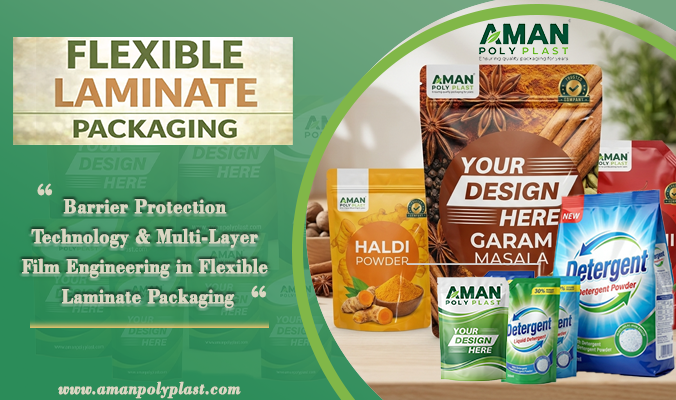
Barrier protection technology in flexible laminate packaging focuses on safeguarding products from external elements such as moisture, oxygen, light, and contaminants by using multiple functional layers that work together to preserve freshness, extend shelf life, and maintain quality. This is achieved through advanced material composition and multi-layer film engineering, where different polymers like PE, PET, BOPP, EVOH, and Aluminium foil are combined, with each layer serving a specific role such as sealing strength, mechanical durability, printability, or high-barrier protection. Together, these engineered layers create a customized packaging structure that balances performance, cost efficiency, and product-specific requirements, making it highly effective for food and industrial applications.
Barrier Technology and Material Engineering
Flexible laminate packaging has become a backbone of modern food preservation, especially in fast-moving consumer goods like snacks and spices. Its importance lies in its ability to create a controlled micro-environment around the product, protecting it from external factors such as moisture, oxygen, light, and contaminants—each of which can significantly degrade food quality.
At the core of its effectiveness is barrier technology. Moisture and oxygen are two of the most damaging elements for packaged foods. When moisture penetrates packaging, products like chips and biscuits lose their crisp texture and may even support microbial growth. Oxygen, on the other hand, drives oxidation reactions, particularly in fat-rich foods, resulting in rancidity, off-flavors, and nutrient loss.
Flexible laminates counter these threats by combining multiple material layers, each serving a specific purpose. Polyethylene provides sealing strength and moisture resistance, while metallized films and Aluminium foil offer excellent barriers against oxygen and light. Advanced polymers such as EVOH further enhance gas barrier properties, making the packaging suitable for highly sensitive products.
Structural Design, Applications, and Functional Benefits
One of the defining strengths of flexible laminate packaging is its structural versatility. Multi-layer laminates can be engineered to match the precise needs of different food categories. In snack packaging, metallized BOPP films are widely favored due to their balance of barrier performance, durability, and printability. These films not only preserve freshness but also maintain visual appeal, which is critical for consumer engagement.
For spices, which are particularly sensitive to environmental exposure, laminates incorporating Aluminium foil or equivalent high-barrier materials ensure that aroma, color, and potency are retained over time. This customization allows manufacturers to optimize both performance and cost efficiency.
Beyond protection, flexible laminates also enhance convenience and functionality. Features like resealable zippers, easy-tear notches, and lightweight designs improve user experience and portability. Compared to rigid packaging, flexible formats reduce material usage and transportation costs, contributing to overall supply chain efficiency. Their adaptability also supports a wide range of packaging formats, including pouches, sachets, and wraps, making them suitable for diverse market needs.
Sustainability, Quality Assurance, and Industry Significance
Sustainability is an increasingly important consideration in packaging innovation. Traditional multi-layer laminates, while effective, can be challenging to recycle due to the combination of different materials. In response, the industry is shifting toward mono-material laminates and recyclable structures that maintain barrier performance while improving environmental compatibility. Developments in biodegradable films and recyclable polyethylene-based laminates are helping brands align with regulatory requirements and consumer expectations for eco-friendly packaging.
Equally critical is the emphasis on quality assurance throughout the manufacturing process. Reliable performance depends on rigorous testing and control at every stage. Raw materials are evaluated for their physical strength and barrier properties before use. Adhesion testing ensures that the layers remain bonded under stress, preventing delamination. Measurements such as Oxygen Transmission Rate (OTR) and Moisture Vapor Transmission Rate (MVTR) are used to quantify barrier effectiveness.
Seal integrity tests confirm that packages remain airtight, while migration testing ensures that no harmful substances transfer from packaging to food. Visual inspections and print quality checks further guarantee that the final product meets both safety and branding standards.
In essence, flexible laminate packaging represents a sophisticated integration of material science, engineering, and quality control. Its ability to preserve food quality, extend shelf life, and adapt to changing consumer and environmental demands makes it an indispensable solution in modern food packaging.